Home/
sports/
Spain's Passing Carousel Stuns France in World Cup Semifinal
sports
Spain's Passing Carousel Stuns France in World Cup Semifinal
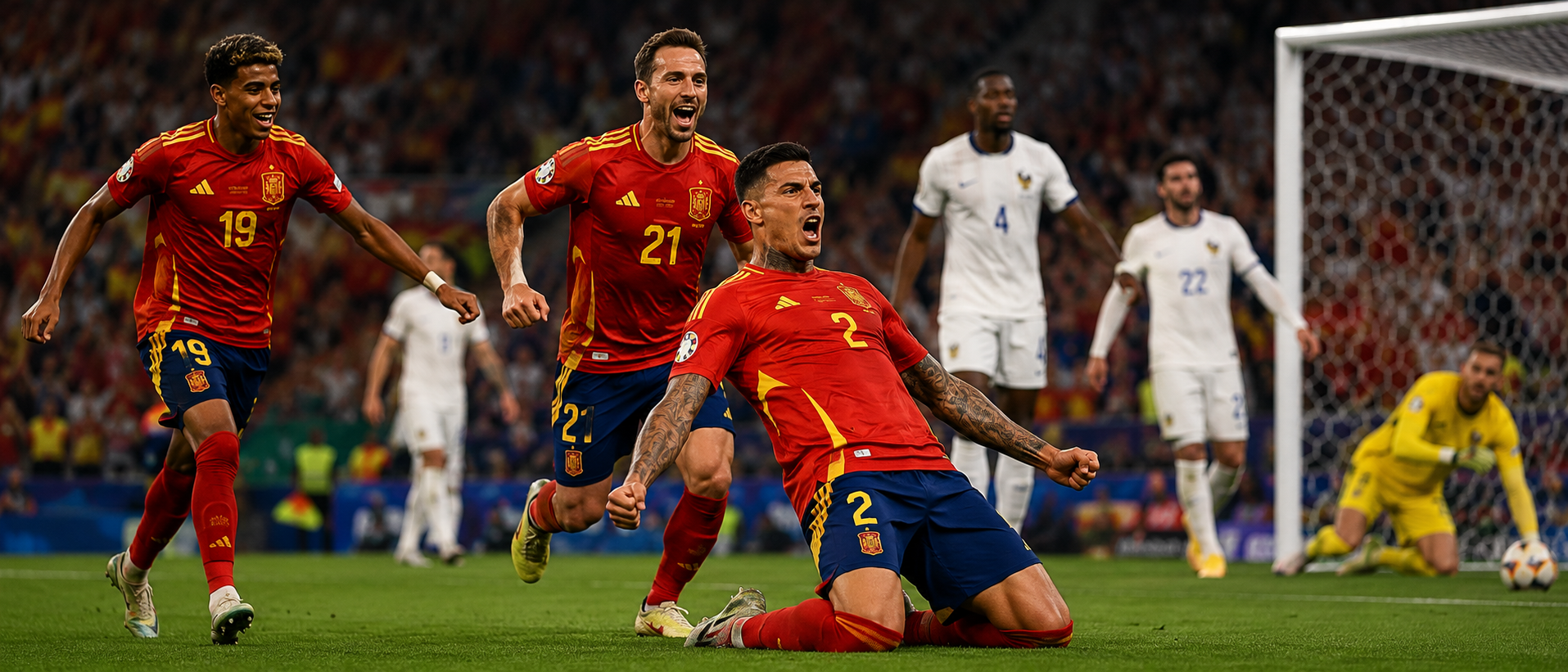
Spain booked their place in the 2026 FIFA World Cup final with a commanding 2-0 win over France in Texas, and the goal that summed up their dominance came from Pedro Porro. Goals from Mikel Oyarzabal and Porro sealed the win, but it was the buildup to the second goal that truly captured how one-sided this semifinal became.
By Iwo Mazur | Last Updated: 15 Jul 2026
The Carousel Takes Over
There's an old football phrase — "the passing carousel" — that Alex Ferguson once used to describe how Barcelona used to toy with opponents during the Frank Rijkaard era, a style Pep Guardiola later perfected. That phrase has stuck to Spanish football ever since, especially after their triumphant 2010 World Cup run. It hadn't really applied to this Spain side, though, not this tournament. They opened with a flat 0-0 draw against Cape Verde and had needed super-sub Mikel Merino to bail them out in extra time during their last two knockout matches. Coming into the France game, most people expected another grind.
That expectation made sense too. France arrived with Kylian Mbappé, Ousmane Dembélé, and Michael Olise, a front three that had been slicing through defenses all tournament with speed and directness. On paper, they looked like the team to beat. What nobody quite realized was that Spain simply hadn't needed to show their full hand yet.
Close to the hour mark, with Spain already 1-0 up from a well-won penalty, the French were forced into chasing the game. That's when Spain turned the screw. Marc Cucurella started it off on the left, feeding it to Aymeric Laporte, who briefly gave possession to goalkeeper Unai Simón before getting it straight back. From there, the ball kept moving — Rodri, then Fabián Ruiz, then Porro — while French players closed in again and again, only to watch the ball slide away just before they arrived.
For about thirty seconds, it looked like pointless sideways passing. But while Spain shuffled the ball around, France's defensive shape quietly fell apart. Laporte spotted the gap and slipped a simple pass through to Dani Olmo, who ran forward unchallenged — there was no French midfield left to stop him — before laying it off to Álex Baena. Baena's shot was blocked but bounced straight back to him, and he found Rodri, who tried an aerial ball toward Lamine Yamal in the box. That too was headed clear, but again the ball fell kindly for Spain, this time to Ruiz, who chested it down and returned it to Rodri.
Midfield Control Built the Difference
Through this entire passage, France barely touched the ball beyond those two defensive headers. Rodri, Ruiz, and Olmo had been steering the game all match, dictating pace and rhythm as if the midfield belonged to them alone. It's worth noting that all three had endured injury-disrupted club seasons and hadn't looked fully sharp earlier in the tournament — Rodri and Ruiz in particular, with Ruiz often coming on as a second-half substitute for Pedri. Against France, though, everything suddenly clicked into place.
Ahead of them, Yamal kept stretching play down the right, Baena worked tirelessly on the left, and Oyarzabal gave the French centre-backs no room to settle. Much like the celebrated 2010 vintage, this Spain team's strength wasn't about individual brilliance — it was about the collective machine functioning as one.
Porro's Moment of Instinct
When Ruiz eventually found Porro out wide, it looked like another lap of the carousel was about to begin. Instead, Porro cut infield, slipped a pass to Olmo in the middle, and immediately sprinted into the French box. It was a bold, decisive run — exactly the kind of instinct Spain had been missing earlier in the competition.
Porro's own tournament story had been a bit shaky. He'd struggled for consistency at club level with Tottenham Hotspur and started the World Cup on the bench. After Spain's underwhelming opener against Cape Verde, head coach Luis de la Fuente brought him in for his attacking threat down the right, and Porro repaid that trust with a goal against Austria in the round of 32. By the semifinal, his starting spot wasn't in question. Many expected him to play a more defensive role against France's dangerous front four, but with Spain controlling 68 percent of possession, Porro found himself pushing forward far more than anyone anticipated, stretching a tiring French back line.
Before playing the pass to Olmo, Porro pointed to the exact spot he wanted the ball returned to. Olmo, despite tight marking from Dayot Upamecano, managed to thread it right into that space. Porro burst onto it with acres of room, since Yamal had already dragged Lucas Digne out wide and Oyarzabal had pulled Maxence Lacroix out of position. Two calm touches later, Porro slotted the ball past goalkeeper Mike Maignan to make it 2-0.
France's players could only look at each other, stunned. On the sidelines, head coach Didier Deschamps appeared visibly rattled — his team had never been taken apart quite like this across four World Cup campaigns. With over half an hour still to play, the result already felt settled.
That 55-second sequence, starting with Cucurella and ending with Porro's finish, said everything about the gap between the two sides that night. Spain had finally shown exactly what they're capable of when they shift gears — and France simply had no answer.







 Home
Home