world

Eastern Europe More Optimistic Than Western Neighbors

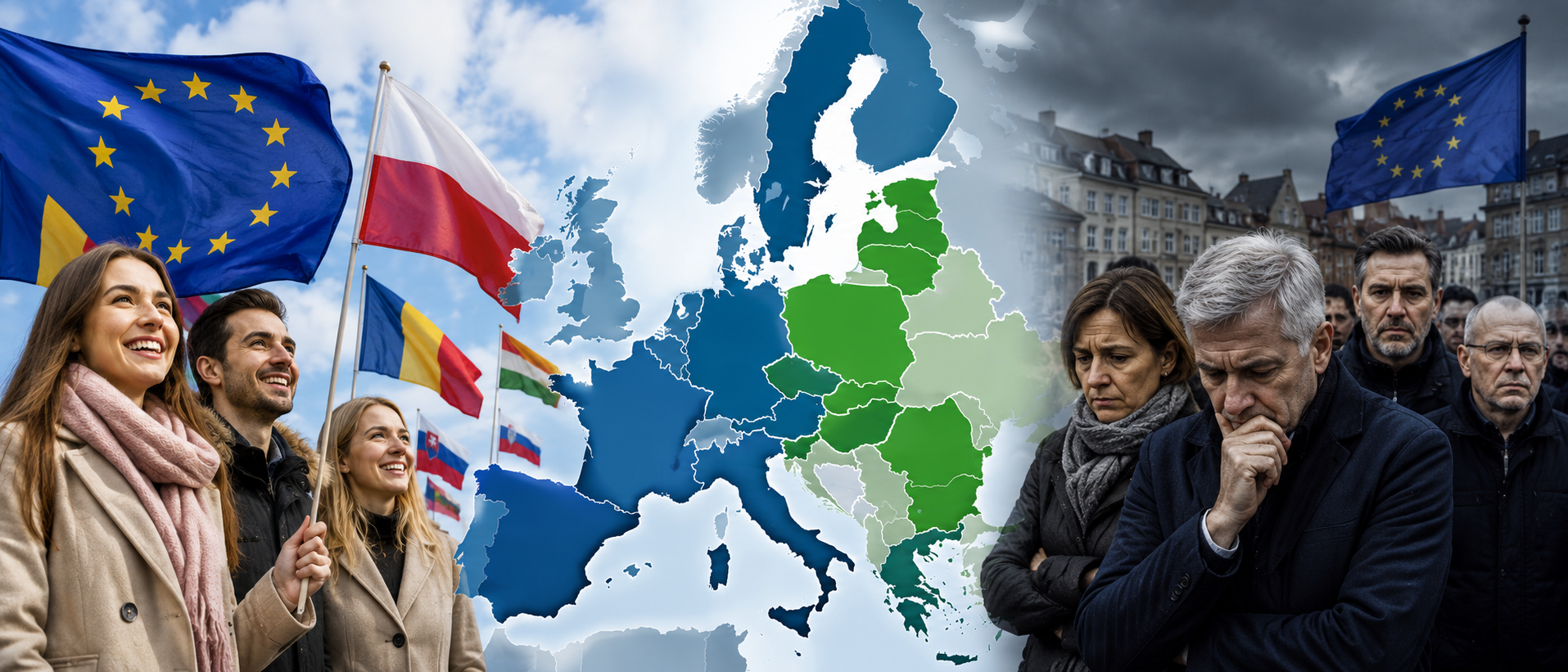
A new survey tracking mood across the European Union has revealed a striking divide: people in eastern member states feel far more upbeat about the world than their neighbors in the west. The gap has become one of the more noticeable trends in the bloc's latest sentiment check, conducted twice a year to take the emotional pulse of Europeans.

By Kamil Wrona | Last Updated: 2 Jul 2026
Poland comes out on top for optimism, with 63 percent of people there saying they feel positive about how the world is heading. Hungary, Lithuania, Slovakia, and Romania follow closely behind, each recording 57 percent. On the flip side, the Netherlands ranks as the most pessimistic country, with 75 percent of its citizens expressing a negative outlook, followed by France at 70 percent, then Germany and Belgium, both sitting at 69 percent. These findings come from the Spring 2026 Eurobarometer survey, which the European Parliament runs regularly to keep tabs on how citizens are feeling.

The EU as a Steady Anchor
Despite the pessimism found in some corners, many Europeans still view the EU as a source of stability amid global turbulence. That said, money worries, especially the rising cost of living, have been building for years now, leaving citizens caught somewhere between hope and uncertainty depending on the day.

Interestingly, the share of people who see the EU as a haven jumped 8 percentage points since the previous survey, taken in October and November 2025. That figure now sits at 75 percent, the second-highest level recorded in the past ten years. Even so, most Europeans remain doubtful about where the world overall is headed, with pessimism climbing 6 percentage points since last time and now outweighing optimism by a wide margin, 58 percent compared to just 38 percent.

Hope, Uncertainty, and Life Satisfaction
When it comes to emotions, uncertainty tops the list across Europe at 44 percent, followed closely by hope at 43 percent, while confidence trails in third place at 33 percent. Hungary stands out as the most hopeful nation, with 57 percent of people there describing themselves as hopeful. Denmark comes next at 55 percent, followed by Finland and Croatia, both tied at 51 percent.

Notably, this survey took place in Hungary not long after a parliamentary election in April brought major political change, with Péter Magyar rising to power and ending Viktor Orbán's 16-year grip on leadership. Compared to the EU average, fewer Hungarians reported feeling uncertain, helpless, or anxious, while confidence, happiness, and determination all scored above average there.

As for overall satisfaction with quality of life, Denmark leads comfortably at 96 percent, followed by Slovenia at 94 percent, then Ireland, Poland, and Sweden, all tied at 93 percent. Greece and Romania sit at the bottom of the list, each at just 63 percent, with Bulgaria close behind at 67 percent.

Related Posts

False Hijack Alert Triggers Fighter Jet Response

False Hijack Alert Triggers Fighter Jet Response

A routine flight from Warsaw to Tel Aviv turned tense when a mistaken hijack alert prompted Israel to scramble two fighter jets to intercept the passenger plane mid-journey.

Ukraine Eyes €10 Billion in Deals at Gdańsk Recovery Forum

Ukraine Eyes €10 Billion in Deals at Gdańsk Recovery Forum

The road to rebuilding Ukraine is moving fast this week. Gathering in the Polish port city of Gdańsk, world leaders and international partners have come together for a major recovery conference — and Ukraine is arriving with serious expectations. Ukrainian Prime Minister Yulia Svyrydenko announced on Thursday that her country anticipates signing more than 160 agreements valued at over €10 billion across the two-day event. The numbers alone signal just how much momentum is building around Ukraine's future.

Rutte Meets Trump to Ease NATO Tensions Before Ankara Summit

Rutte Meets Trump to Ease NATO Tensions Before Ankara Summit

With a high-stakes NATO summit just weeks away, Secretary-General Mark Rutte has traveled to Washington to meet President Donald Trump at the White House on Wednesday. The visit is a carefully timed diplomatic mission, aimed at defusing growing frustration within the alliance and keeping Trump engaged ahead of the July 7-8 summit in Ankara. At the heart of the tension are disagreements over the Iran conflict, threats of US troop withdrawals from Europe, and a broader sense that the transatlantic alliance is being tested like never before.

Kyiv Pride 2025 Draws 5,000 in Wartime Ukraine

Kyiv Pride 2025 Draws 5,000 in Wartime Ukraine

In a show of resilience that few cities at war could pull off, around 5,000 people took to the streets of Kyiv on Sunday for the city's annual Pride March — the largest LGBTQ+ gathering in the Ukrainian capital since Russia launched its full-scale invasion in 2022. The march brought together a remarkably broad crowd: LGBTQ+ individuals, active-duty soldiers, veterans, human rights defenders, diplomats, and supporters from across the country. It ran for roughly two hours before wrapping up, coinciding with a Russian drone strike on the capital as it drew to a close.

Ukraine Strikes Moscow Refinery Again in Major Drone Attack

Ukraine Strikes Moscow Refinery Again in Major Drone Attack

The skies over Moscow turned smoky and chaotic on Thursday as a large wave of Ukrainian drones targeted the Russian capital, hitting its main oil refinery for the second time in a single week. Kyiv framed the assault as proof of its expanding long-range capabilities and as a clear signal to Moscow that continuing the war comes at a real cost at home. Russia, meanwhile, answered with its own missiles aimed at Kyiv, keeping the cycle of strikes firmly alive on both sides.

Ukraine Pushes Peace Talks From Position of Growing Strength

Ukraine Pushes Peace Talks From Position of Growing Strength

When Ukraine's president extends an olive branch to Vladimir Putin, it's tempting to read it as desperation. But analysts watching the war closely say the opposite is true. Kyiv's renewed push for direct talks isn't a sign that Ukraine is struggling — it's a calculated move from a country that believes the momentum is shifting in its favor.

Advertisement

LATEST INSIGHTS

Potrzebujemy chwili Twojej uwagi

Uwielbiamy pliki cookie — zarówno te jadalne, jak i cyfrowe, które ulepszają Twoje wrażenia z przeglądania. Pomagają nam one udoskonalać funkcjonalność naszej witryny i Twoje ogólne wrażenia. Podstawowe i funkcjonalne pliki cookie są niezbędne do prawidłowego działania witryny i nie można ich wyłączyć. Ponadto używamy plików cookie w celu optymalizacji wydajności („komfort”) i wyświetlania spersonalizowanych reklam („marketing”), na co potrzebujemy Twojej zgody. Kliknij „Zezwól na wszystkie”, aby wyrazić zgodę na przetwarzanie danych. Uwielbiamy pliki cookie — zarówno te jadalne, jak i cyfrowe, które ulepszają Twoje wrażenia z przeglądania. Pomagają nam one udoskonalać funkcjonalność naszej witryny i Twoje ogólne wrażenia z przeglądania. Podstawowe i funkcjonalne pliki cookie są niezbędne do prawidłowego działania witryny i nie można ich wyłączyć. Ponadto używamy plików cookie w celu optymalizacji wydajności („komfort”) i wyświetlania spersonalizowanych reklam („marketing”), na co potrzebujemy Twojej zgody. Kliknij „Zezwól na wszystkie”, aby wyrazić zgodę na przetwarzanie danych.

Twoja zgoda obowiązuje również na mocy art. 49 (1) (a) RODO, co oznacza, że ​​Twoje dane mogą być tymczasowo przetwarzane poza EOG, w tym w USA. W takich przypadkach wysokie europejskie standardy ochrony danych mogą nie być w pełni zagwarantowane, a władze USA mogą uzyskać dostęp do Twoich danych bez skutecznego środka prawnego. Możesz wycofać swoją zgodę w dowolnym momencie.

PrywatnośćWarunki korzystania z serwisu

Możesz zarządzać swoimi preferencjami dotyczącymi plików cookie lub wycofać zgodę w dowolnym momencie za pośrednictwem naszych ustawień plików cookie. Aby uzyskać więcej informacji, zapoznaj się z naszą Polityką prywatności.